
How to Ask for a Skin Fade (Without Sounding Like You Googled It)
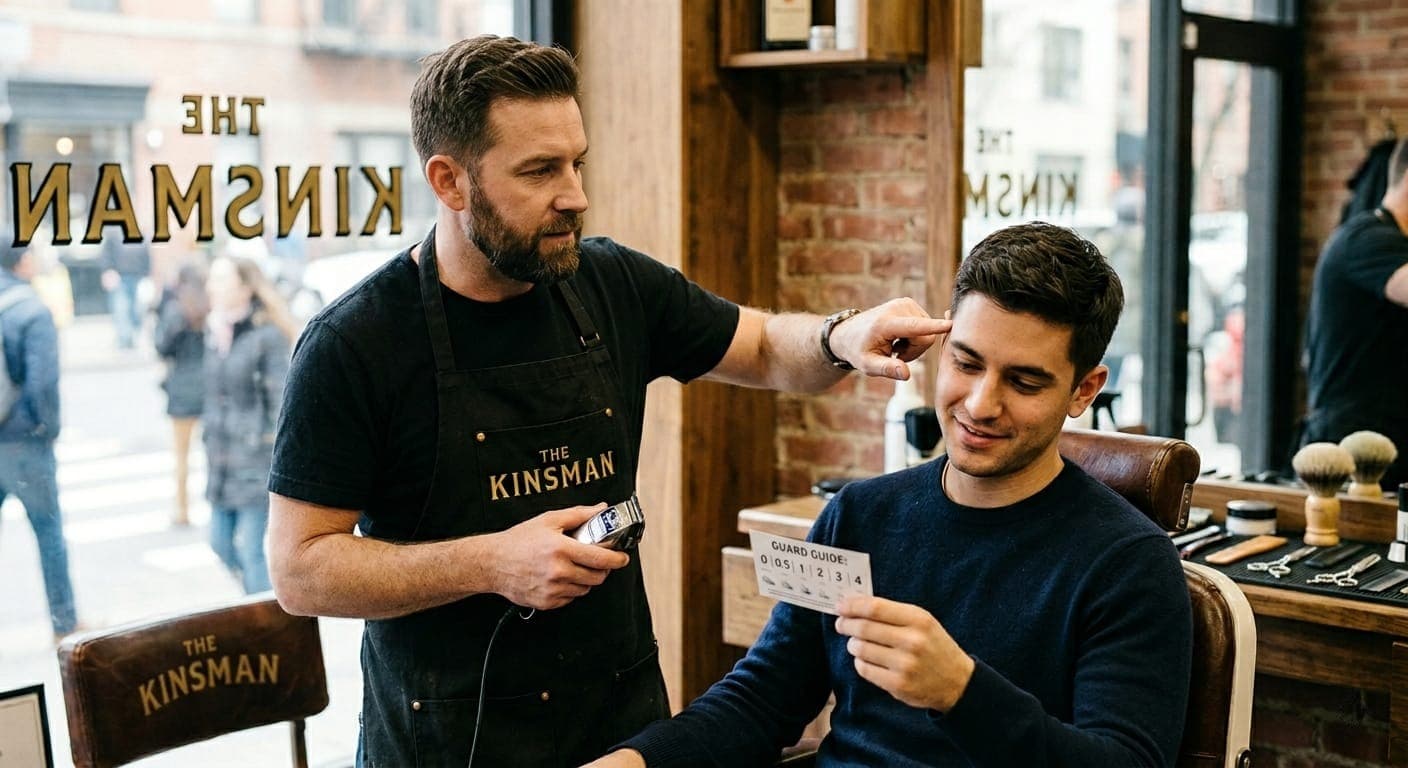
You already know you want a skin fade. You've seen it on Instagram, maybe on a friend, maybe on yourself a few years ago when a barber got it exactly right and you've been chasing the same cut ever since. The problem isn't the cut — it's the conversation. You sit down, the chair tilts back, and the barber asks, “what are we doing today?” How to ask for a skin fade so you actually walk out with the one you pictured is a short skill, not a mystery. This guide is the cheat sheet a Kinsman barber wishes every first-timer had in their pocket before they sat down.
We cut skin fades at The Kinsman in the West Village all day. Below is the exact vocabulary we listen for, the three dials we dial in, and the short phrasebook we'd hand a friend before their first appointment with a new barber.
First, the three dials your barber is listening for
Every skin fade — every fade, actually — comes down to three decisions. Name these three and your barber will build the cut on the spot.
1. Where does the fade start?
This is the vertical height on your head where the clippers start the gradient. Three common answers:
Low fade.The gradient starts just above the ear. Subtle. Reads as “sharp haircut” rather than “fade haircut.”
Mid fade. Starts around your temple, halfway between ear and crown. Most requested.
High fade. Starts up by the crown. Bold, very visible, more contrast on top.
Say it in one phrase: “low skin fade,” “mid skin fade,” or “high skin fade.”We'll take it from there.
2. How short does it go at the bottom?
“Skin fade” already answers this — the bottom is bare skin, no guard. If you don't want bare skin, you don't want a skin fade; you want a taper or a low fade. The distinction matters, and getting it wrong is the single most common miscommunication in a barbershop.
If you want almost bare skin but a bit softer, the barber term is “zero-grade” or “balded out to zero.” Same idea, tiny bit of fuzz left.
3. How does the fade connect to the top?
This is the bit people forget. The fade is the sides. You still need to tell your barber what's happening on top. Three useful phrases:
“Scissor finish on top.” The top is cut with scissors, keeps natural texture.
“Blended in.” You want a smooth transition from the fade to the longer hair.
“Hard line” or “disconnected.” You want a visible line where the fade ends and the length on top begins. Sharper, more graphic.
Three dials: where, how short, what's on top. Nail those and you've already asked for a skin fade better than 90% of walk-ins.
The phrasebook: what to actually say
Here's the template. Fill in the blanks.
“Can I get a [low / mid / high] skin fade, with a [scissor finish / blended / hard line] top, and leave about [2 inches / whatever length] on top?”
That's it. Three concrete examples:
The one-sentence skin fade
“Mid skin fade, blended into a scissor finish, leave about 2 inches on top.”
The more specific version
“High skin fade, start the fade at the temple, blend into a scissor finish on top. Keep about 2.5 inches on top with natural texture — no pomade look.”
When you want to show a photo
“I like the fade height and contrast in this photo — can we match the fade? On top I'd like a little more length than this picture shows.”
Photos are great. Bring them. Barbers aren't offended by photos; we prefer them. Just frame the photo as a starting point, not a demand — the cut has to work on your head shape, hairline, and density, not the model's.
Barber terms you'll hear (and what they actually mean)
If you walk into a shop and a word pops up you don't know, here are the ones that come up in a skin fade consult most often.
Guard number. The plastic attachment on the clippers. 0 is skin.A 1 is about 1/8 inch, a 2 is 1/4 inch, a 3 is 3/8 inch. By the time you're at a 4, you're keeping a lot of visible length. Skin fades bottom out at 0 with no guard.
Fade line.The horizontal line where the fade starts vertically on your head. “Higher fade line” = the gradient starts further up.
Drop fade.The fade line dips down behind the ear — it “drops” toward the nape. More visible profile.
Burst fade. The fade fans outward around the ear like sun rays, leaving the back longer. Often paired with mohawk-ish tops.
Scissor work / scissor finish. The top is cut with shears, not clippers. Softer, more natural texture.
Blend / blending. The invisible gradient between two lengths. “Blended in” = no visible line.
Taper.A taper keeps visible length on the sides and only shortens around the sideburns and neckline. It's not the same as a fade — don't use the words interchangeably. (We broke this down in the Taper Fade vs. Skin Fade vs. Mid Fade guide if you want the side-by-side.)
Hard part. A line shaved into the hair to create a visible part. Optional add-on, usually free.
Neckline. The shape of the hairline at the back of your neck. Three choices: square (sharp corners), rounded (soft corners), natural (the barber follows your actual hairline, cleaned up). For a skin fade, natural or rounded tends to age best between cuts.
Three things we wish every first-timer knew
A skin fade grows out in ten days, not thirty
The bottom of a skin fade is the part that looks the sharpest on day one and the fuzziest on day fourteen. By day twenty-one the contrast is gone and it looks like a soft mid fade. If you can only come in every four to six weeks, a skin fade is going to spend more of that time looking grown-out than sharp. A low fade or a taper is a much better match for a monthly cadence. Match the cut to your calendar.
“Number 1 all over” isn't a skin fade
This one trips up a lot of people. A 1 guard all over is a buzz cut — same length everywhere, no gradient. A skin fade has a gradientfrom bare skin at the bottom up to whatever length on top. If you've been saying “number one, please” at old-school shops and assuming you're getting a fade, you haven't been — you've been getting a buzz cut.
The top matters as much as the fade
A perfect skin fade paired with a mediocre cut on top still looks mediocre. The top is where your barber's scissor work shows. Spend as much time describing what you want on top (length, texture, part, how much movement) as you do on the fade. A good barber will ask; a great one will keep asking as they work.
What to ask about the top
Here's the short checklist for the top part of a skin fade. Pick one answer per row and you're set.
Length: “about an inch,” “two inches,” “finger-length,” or “keep most of what's there.”
Texture: “cut smooth and tight” (clean/formal) or “leave some texture, don't blunt it off” (more casual, more movement).
Part:“I part it on the left/right,” “I wear it pushed back,” or “I don't part it.”
Styling:“I use pomade,” “I use matte paste,” “I don't use anything.” This matters — it tells the barber how to cut so the top sits the way you style it.
What to do if the cut isn't quite right
Tell us. Mid-cut is the best time to speak up — it's two minutes of extra clipper work versus two weeks of regret. Specific feedback works best: “Can we take the fade up a bit higher?” or “Can we leave a little more length right on top?” or “Can the neckline be a bit rounder?” We're not offended. We'd much rather fix it now.
If you notice something at home later, most shops (including Kinsman) will do a small tidy-up within the first week at no charge. Call, explain, come in. That's what the shop is for.
How to book a skin fade at The Kinsman
Our menu lists one service for all fade variants — Skin Fade ($70). Booking that service gets you the full thirty minutes with a barber who'll work through the three dials with you. If you want a taper instead, that's fine too — same service, the barber just dials the clippers differently. You can book a skin fade online or walk in during business hours. First time at a traditional shop? Have a read through what to expect on your first visit first — it covers cash-only payment, how we run the chair, and what to order alongside the cut.
If you're still deciding between a taper, mid, and skin fade, the Taper Fade vs. Skin Fade vs. Mid Fade guide has a side-by-side breakdown with a decision tree.
Frequently asked questions
What's the difference between a skin fade and a bald fade?
Nothing. Two names, same cut. Some shops call it “bald fade,” some call it “skin fade,” a few say “zero fade.” At The Kinsman we call it a skin fade on the menu. If you say any of the three, your barber will know what you mean.
Can I ask for a skin fade if my hair is thinning?
Usually yes, but it depends on whereyou're thinning. A skin fade on the sides can actually look great if the thinning is on top — the contrast draws the eye down. If the thinning is on the sides (above the ear, around the temples), a skin fade exposes more scalp there, which may be the opposite of what you want. Tell your barber where the thinning is and ask for an honest read. A low fade or a taper is sometimes the smarter call.
How often should I book a skin fade touch-up?
Every two to three weeks to keep it looking like day one. Every three to four weeks is the realistic cadence most guys settle into. Beyond four weeks the contrast is mostly gone. We recommend a standing appointment every three weeks for regulars on a skin fade — consistent, no decision fatigue, same barber each time.
Is it rude to bring a photo to a barber?
The opposite. Photos are the fastest way to communicate. The only rule: bring a photo of a real haircut on a real person, not a Pinterest render or an AI-generated image. And be realistic — the cut has to work on your head and hair, not the model's.
Do you charge more for a skin fade than a regular haircut?
No. At The Kinsman a skin fade is $70, the same as any of our fade variants. One price, your call on the style. See the full list on the services page.
Ready to ask for a skin fade like a regular?
Book a skin fade with one of our barbers at The Kinsman, 103 W 10th Street. Bring the three dials — we'll handle the rest.
Book a Skin FadeMore from The Kinsman: Read the Taper Fade vs. Skin Fade vs. Mid Fade guide or what to expect on your first visit to the shop.
About The Kinsman
The Kinsman is a men's barbershop at 103 West 10th Street in the West Village, Manhattan. Precision haircuts, beard trims, and hot towel straight razor shaves — seven days a week, walk-ins welcome.