
The Complete Guide to Getting a Perfect Beard Trim in the West Village
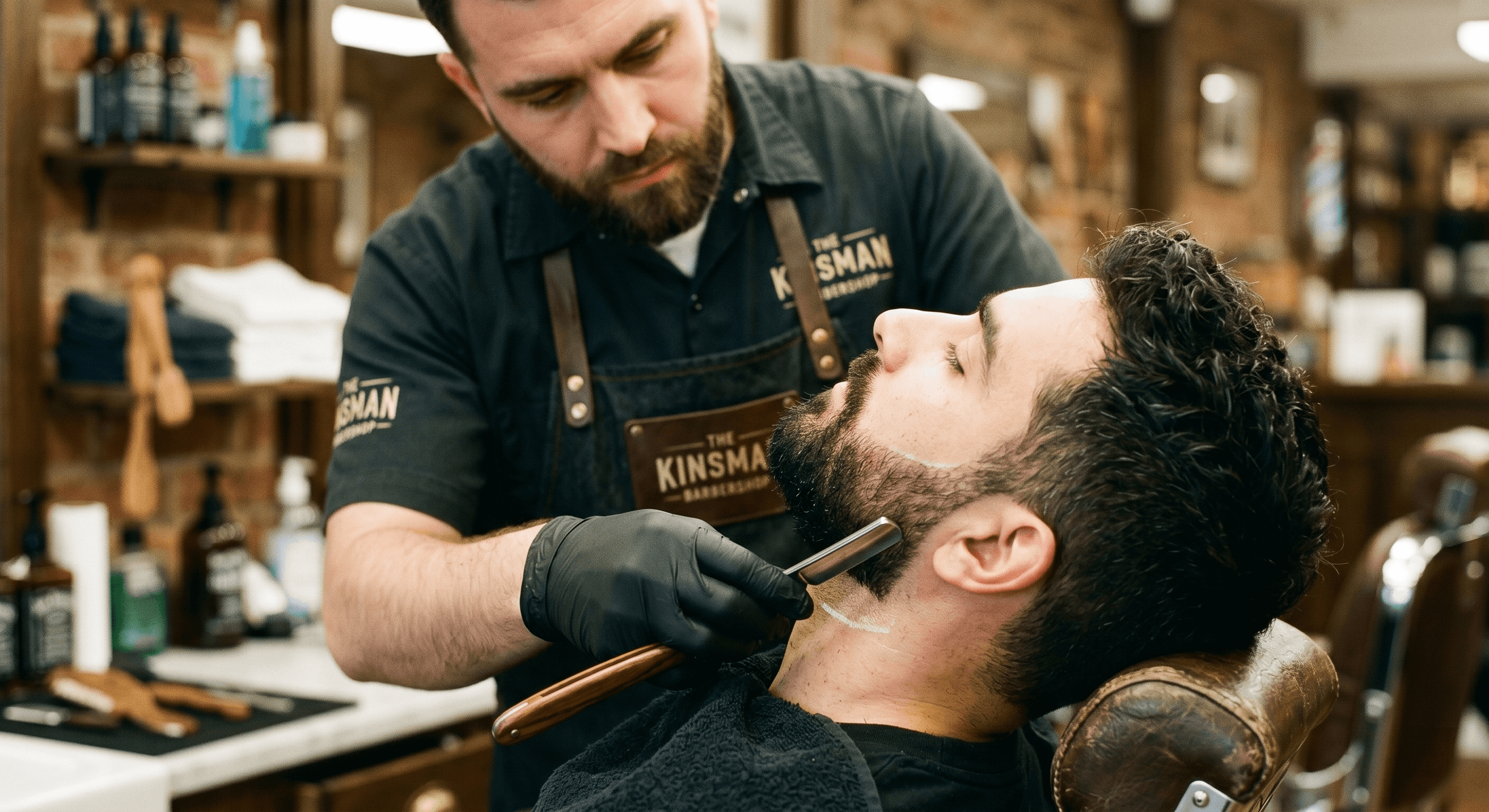
Here's what happens to most beards: a guy grows one out, it looks decent for about two weeks, and then it quietly crosses the line from intentional to neglected. The neck gets fuzzy. The cheek line creeps up unevenly. One side starts growing faster than the other and nobody tells him because nobody knows how to bring it up.
The difference between a beard that looks like a choice and a beard that looks like you forgot to shave isn't length or thickness — it's shape. And shape is what a professional beard trim is actually for.
If you're in the West Village or anywhere nearby and you've been trimming your own beard with a bathroom mirror and a pair of clippers, this is the guide that explains what you're missing, what a barber actually does differently, and why a $30 trim every two to three weeks changes the way your whole face looks.
What a Professional Beard Trim Actually Involves
A beard trim at a barbershop isn't just “make it shorter.” At The Kinsman, a beard trim is a shaping service, and it covers more ground than most guys expect the first time they sit down for one.
Here's what happens in the chair:
The consultation. Your barber looks at your beard — the density, where it grows thick, where it's patchy, how it sits against your jawline and neck. They'll ask what you're going for. A tight, corporate-clean beard is a different shape than a full, natural beard, and both require different lines and lengths. If you don't know what you want, your barber can recommend a shape based on your face structure. That's half the value.
The neckline.This is the part most guys get wrong at home, and it's the single biggest reason beards start looking unkempt. A professional neckline isn't a straight line across your throat — it's a curved line that follows the natural angle of your jaw, set just above your Adam's apple. Too high and it looks like a chinstrap. Too low and you lose the clean edge entirely. Your barber sets this line with a straight razor, which means the edge is sharp, precise, and clean in a way no electric trimmer can match.
The cheek line. The other line that makes or breaks a beard. Some guys have a naturally clean cheek line. Most don't. Your barber defines it — deciding how high the beard sits on the cheek, whether the line is sharp or softly faded, and making sure both sides match. This is the kind of detail that's nearly impossible to get right on your own because you can't see both sides of your face at the same angle at the same time.
The shape and length. Once the edges are set, the barber brings the body of the beard into proportion. Longer at the chin, tighter on the sides, tapered at the sideburns to blend into your haircut. The goal isn't uniform length — it's a shape that complements your face. A round face usually benefits from a beard that's slightly longer at the chin and tighter on the cheeks. A longer face does better with more fullness on the sides. Your barber reads the geometry and adjusts accordingly.
The details. Mustache trimmed so it's not hanging over your lip. Stray hairs caught. Any patchiness worked around rather than exposed. A good barber treats the beard like a haircut — it's not done until every angle looks intentional.
Why You Can't Get the Same Result at Home
This isn't gatekeeping. It's geometry.
Your bathroom mirror shows you a flat, front-facing view of your beard. Your barber sees it from every angle — the sides, underneath, the profile. They can see asymmetry you'll never catch. They can see where the neckline is creeping down on the left side but not the right. They can see that your beard grows denser on one cheek and adjust the trim to compensate.
Then there's the tooling. A straight razor creates a neckline and cheek line that a trimmer guard physically cannot replicate. The edge is cleaner, the transition from beard to skin is sharper, and the result lasts longer before stubble blurs the line.
And there's the objectivity. You've been looking at your own face every day for years. You've stopped seeing it clearly. A barber sees it fresh every time and can tell you honestly what shape suits you — not what you've gotten used to.
Does that mean you shouldn't maintain your beard between visits? Of course not. You should. But think of it like a haircut: you might run some product through your hair on a Tuesday morning, but you're not cutting it yourself. Same principle.
How to Talk to Your Barber About Your Beard
If you've never had a professional beard trim, the consultation can feel awkward. You might not have the vocabulary. That's completely fine. Here are a few ways to communicate what you want without needing to know the jargon:
Bring a photo. Just like with a haircut, a reference image saves a hundred words. Find a beard shape you like on someone with a similar face shape and show your barber.
Describe the vibe, not the specs. “I want it to look clean but not corporate” tells your barber more than “take it down to a four on the sides.” If you can describe the impression you want the beard to give, your barber can translate that into technique.
Tell them what's bothering you. “The neck always gets out of control” or “it looks uneven” or “I feel like it's too round” — these are useful starting points. Your barber can fix the specific problem rather than guessing what you don't like.
Say how much maintenance you want to do. If you're coming in every two weeks, your barber can keep a tighter shape. If you're more of a once-a-month guy, they'll build in more room for growth. Both are valid — the trim just needs to be designed for your schedule.
Between Trims: What Actually Matters
You don't need a cabinet full of beard products. You need three things:
Beard oil or balm. This isn't vanity — it's skincare. The skin under your beard gets dry, especially in the winter, and dry skin leads to itchiness and flaking. A light oil after you shower keeps the skin healthy and the beard soft. A few drops. That's it.
A comb or brush. Train your beard to lay the way you want it. A quick brush-through in the morning takes ten seconds and keeps everything moving in the right direction between trims.
Restraint with the trimmer. If you must clean up between visits, stick to the neck. Don't touch the cheek line. Don't try to reshape the sides. The neck is forgiving. The cheek line is not. One slip and you're chasing symmetry all the way down to a goatee you didn't want.
Why the West Village
The West Village has always been a neighborhood that values things done well over things done fast. That's why we opened The Kinsman here, and it's why a beard trim at our shop takes the time it takes. We're not racing to the next chair. We're making sure the lines are right, the shape suits your face, and you leave looking like the beard was always the plan.
A beard trim at The Kinsman is $30. It takes about fifteen to twenty minutes. And for most guys who try it once, it becomes the thing they wish they'd started doing years ago.
More from The Kinsman: Read about your first visit to the shop or why we opened in the West Village.
About The Kinsman
The Kinsman is a men's barbershop at 103 West 10th Street in the West Village, Manhattan. Precision haircuts, beard trims, and hot towel straight razor shaves — seven days a week, walk-ins welcome.