
Barber vs. Salon: When Should a Man Choose a Traditional Barber Shop?
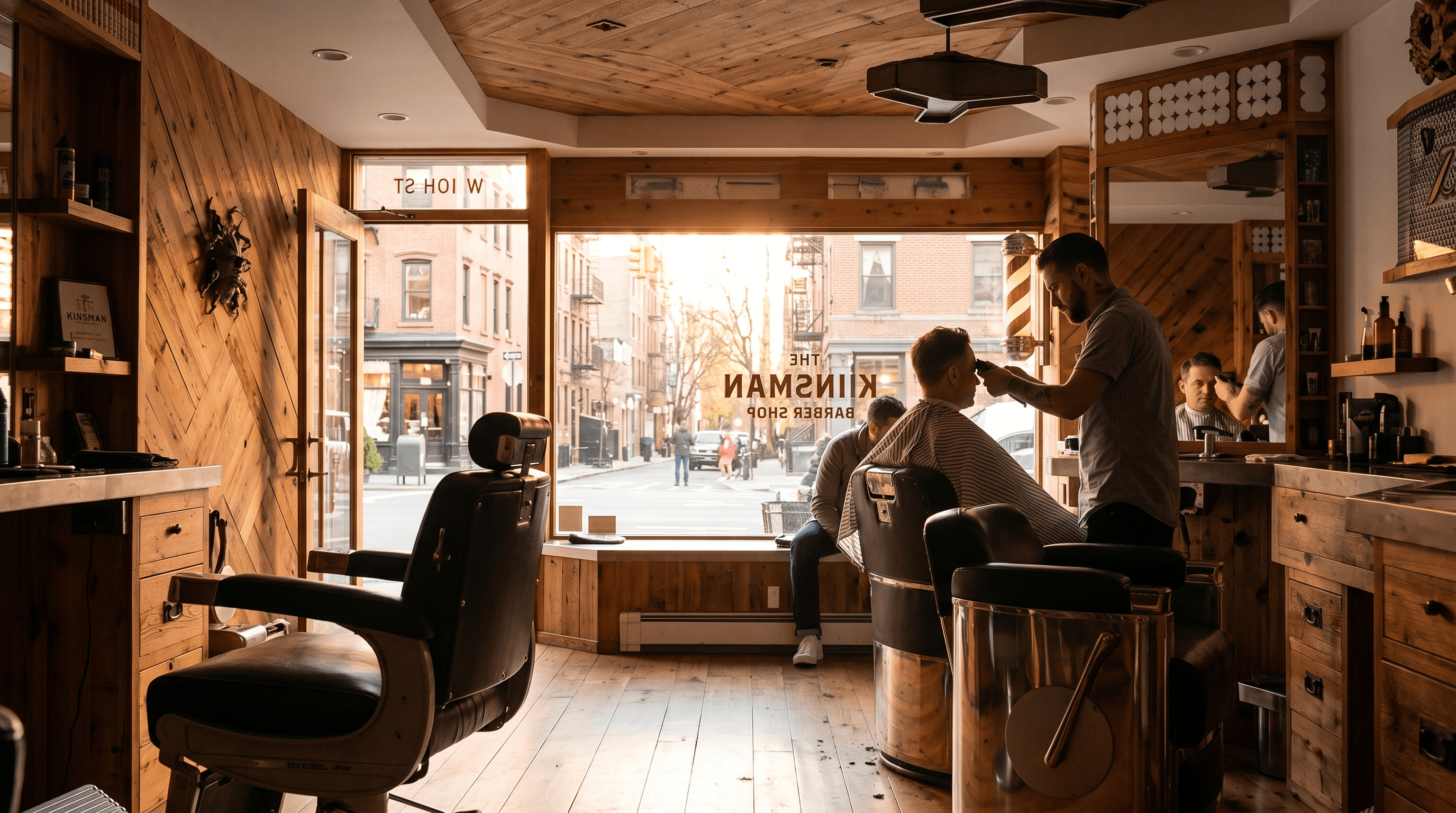
If you've ever stood on a sidewalk in Manhattan staring at two haircut places three doors apart — one with a striped pole, one with a blow-dryer in the window — and wondered which one you're actually supposed to walk into, you are not alone. The line between barbershops and salons has gotten blurrier over the last decade. Salons take walk-ins for men. Barbershops sell pomade and offer beard oils. Both can give you a perfectly good haircut.
But they're still different rooms with different training, different tools, and different ideas about what a men's haircut is supposed to do. And depending on what you want out of your hair, one of them is going to fit you better than the other.
Here's the honest, no-tribal-loyalty breakdown of when a man should choose a traditional barber shop — and when a salon might actually be the right call instead.
What a Barbershop Actually Specializes In
A traditional barber shop is built around a specific craft: short to medium men's hair, clipper work, fades, tapers, beards, and straight razor finishing. That's the whole language of the room. Every chair, mirror, tool, and technique is set up to do that work cleanly and quickly.
Barbers train differently than stylists. The license is its own credential. The curriculum centers on clipper-over-comb, blade work, neckline and cheek line shaping, and the geometry of a fade — how to blend skin into a one guard into a three guard so smoothly you can't see the seam. You don't learn that doing balayage. You learn it doing two thousand fades.
The other thing a barbershop is set up for is the consult. A good barber will look at your face shape, hairline, growth patterns, and lifestyle and tell you what works. The vocabulary is shared. You can say “low taper, scissor on top, leave the texture” and the barber knows exactly what you're asking for. That common language matters more than people think. Most haircut disasters happen in the translation, not the cutting.
What a Salon Actually Specializes In
Salons are built around a different craft: longer hair, color, chemical work, scissor-driven shaping, and styling that involves heat tools and product application. A salon stylist's training is heavier on color theory, texture services, and longer-form scissor cutting than a barber's.
If you have hair that lives below your jaw, hair you want to color or highlight, curls you want shaped with a curl specialist, or a style that's really about how it's blow-dried into shape — a salon is genuinely the better room. A salon stylist who cuts a lot of men's long hair will give you a better long shag than most barbers. And if you want gray blended out or a subtle color, that's not what a barbershop does well, if at all.
None of that is a knock on barbers. It's a different skill set. The mistake most men make is assuming the two rooms are interchangeable because both happen to involve hair.
When a Traditional Barber Shop Is the Right Call
Choose a barbershop when any of the following is true:
You want a fade, taper, or any clipper-driven cut. Skin fade, low taper, mid fade, high and tight, crew cut, buzz, French crop with a faded back — this is the barbershop's entire reason for existing. The blending, line work, and finish you get from a working barber are hard to match in a salon, where clippers are usually a supporting tool rather than the main one.
You have short to medium hair and you want it to look intentional. Anything from a half-inch buzz up to four or five inches on top is firmly barber territory. The shape comes from how the sides relate to the top, and barbers are the people who spend all day thinking about that relationship.
You have a beard, mustache, or stubble you want shaped. Beard trims, neckline shaping, cheek line definition, and hot-towel straight razor shaves are barber services. Salons don't generally do them, and when they do, it's rarely with a real straight razor on a real strop.
You want clean lines and a sharp neckline. The crisp neckline at the back of your head, the sharpness around the ears, the tight edge over the sideburn — that level of finish is a barber's signature. A straight razor edge lasts longer and looks cleaner than a trimmer guard.
You want it done in a reasonable time. A traditional barber shop is fast without being rushed. Forty-five minutes, in and out, neat work, no styling ritual you didn't ask for. If you have a job, a kid, or a Saturday morning that has more than one item on it, that pacing matters.
You want walk-ins to be possible. Most salons run on appointments only. Most barbershops keep a few chairs open for walk-ins because that's how the trade has always worked. If you live nearby and like the idea of stopping in on a quiet Tuesday, a barbershop fits that life.
You want consistency you don't have to explain every time. Once your barber knows your hair — how it grows, where the cowlicks are, how high the fade should sit, how long the top should sit on a Friday vs. a Monday morning — you stop having to brief them. You sit down, they start. That's a particular pleasure of having a regular barber.
When a Salon Might Actually Be Better
We're not in the business of pretending barbershops do everything. They don't. Choose a salon when:
Your hair is long — really long. Past the shoulders, layered, styled around your face. A stylist who specializes in long men's hair will give you a better cut than a barber whose week is mostly fades.
You want color, highlights, or gray blending. This is a salon service. Even the few barbershops that offer color usually outsource the actual work to a colorist.
You have curly or coily hair and want a curl-specialist cut. There are salons that specialize in cutting curls dry, one ringlet at a time, and the result is genuinely different from a clipper-and-scissor cut. If your curl pattern is what defines your hair, that specialty matters.
You want chemical services — relaxers, perms, smoothing treatments. Salon territory.
A good rule of thumb: if your haircut involves a flat iron, a color bowl, or anything with the word “treatment,” go to a salon. If it involves clippers, a fade, or a straight razor, go to a barbershop.
The Atmosphere Difference (and Why It Matters)
The thing nobody puts in a comparison chart but everyone feels: barbershops and salons are different rooms.
A barbershop is, at its best, an unhurried place built for men. The chairs are wider. The mirrors are bigger. The conversation is loose. There's usually a sport on a screen somewhere or a record playing. You don't feel like a guest in someone else's living room. You feel like you walked into a workshop. For a lot of men, that matters more than they realize until they experience it. It's thirty to sixty minutes a few times a month where the whole point is that someone else is taking care of something for you.
Salons have their own pleasures — they tend to be lighter, more polished, more about the styling experience. Both are valid. Just different.
A Quick Way to Decide
If you want a single sentence: choose a barbershop when the most interesting thing about your haircut is happening on the sides. Choose a salon when the most interesting thing is happening on top, around the face, or in the color.
For most men — short to medium hair, a fade or taper, a beard to keep in line, a neckline that needs to stay sharp — the answer is a traditional barber shop. That's what we do at The Kinsman, and that's why we built the room the way we did.
Why Choose a Traditional Barber Shop in the West Village
The West Village is full of options — salons, barbershops, fast-chain places that try to be both. The argument for a traditional barber shop in this neighborhood is the same as the argument for the West Village itself: things done well, by people who care, in rooms that have a point of view.
A traditional barbershop in this neighborhood isn't trying to be a salon. It's trying to be the best version of what a barbershop is — a place a man walks into and walks out of looking sharper than when he came in, in less time than it would take to figure out where else to go. That's the whole pitch.
Ready to sit in a real barber chair?
Book a haircut at The Kinsman, 103 W 10th Street — a traditional barber shop in the West Village.
Book an AppointmentMore from The Kinsman: Read about your first visit to the shop, the difference between fades, or why we opened in the West Village.
About The Kinsman
The Kinsman is a men's barbershop at 103 West 10th Street in the West Village, Manhattan. Precision haircuts, beard trims, and hot towel straight razor shaves — seven days a week, walk-ins welcome.